
Paul Hogan is an Australian actor and comedian who captured the hearts of millions with his iconic portrayal of the outback adventurer in one of cinema’s most beloved franchises. Known for his rugged charm, quick wit, and unmistakable Aussie accent, Hogan became a household name in the 1980s and remains a cultural icon to this day. His journey from working as a rigger on the Sydney Harbor Bridge to becoming one of Australia’s most recognizable entertainers is nothing short of remarkable. Paul Hogan net worth reflects both his tremendous success and the challenges he faced throughout his remarkable career.
Beyond his acting prowess, Hogan demonstrated exceptional business acumen by independently financing his breakthrough film, a decision that would lead to extraordinary financial rewards and significantly boost Paul Hogan net worth. However, his financial journey has been far from smooth, marked by legal battles, tax disputes, and personal challenges that significantly impacted his wealth over the years.
What Is Paul Hogan’s Net Worth?
Paul Hogan commands a net worth of $20 million, a figure that reflects both his tremendous success and the financial setbacks he has endured throughout his career. He is most famous for appearing in the 1986 movie “Crocodile Dundee” and its sequels, a role that catapulted him to international stardom. Hogan didn’t just star in the film; he created the Dundee character, wrote the screenplay, and famously raised the financing for the first film on his own, allowing for an unusually large payday.
His ownership of 60% of the profits generated by the first movie positioned him for unprecedented earnings. He then executive produced the film’s 1988 sequel, further solidifying his financial stake in the franchise. Paul Hogan net worth peaked at north of $75 million during the height of his career, making him one of Australia’s wealthiest entertainers.
Unfortunately, Paul Hogan net worth has declined significantly in recent years after an ugly divorce and a lengthy battle with the Australian Taxation Office. These financial challenges eroded much of his accumulated wealth, bringing his fortune down from its impressive peak. Despite these setbacks, Hogan’s contributions to Australian culture and the entertainment industry remain invaluable.
Paul was made a Member of the Order of Australia (AM) in 1986 for “service to tourism and entertainment,” an honor that recognized his impact on promoting Australia to the world. His work not only entertained millions but also played a crucial role in boosting Australian tourism during the 1980s and beyond.
Early Life
Paul Hogan was born on October 8, 1939, in Sydney, Australia, where he would spend his formative years developing the personality and humor that would later define his career. In an attempt to appear more interesting, he has at times claimed to have been born in the small outback town of Lightning Ridge, Australia, a claim that added to his rugged, outback persona.
He grew up in Sydney and began working as a rigger on the Sydney Harbor Bridge as a teenager, a physically demanding job that required strength, courage, and a good sense of humor to get through long days. This working-class background would later inform his most famous character and give him an authentic connection to everyday Australians.
Hogan has remained private about many of the details related to his career prior to entering show business, preferring to let his work speak for itself rather than dwelling on his humble beginnings. His time as a rigger taught him valuable life lessons about hard work, perseverance, and the importance of not taking oneself too seriously. These qualities would become hallmarks of his comedic style and contribute to his widespread appeal. The contrast between his blue-collar roots and his eventual international fame made his success story even more compelling to audiences worldwide.
Early Career
Hogan’s first appearance on Australian television came in 1971 with the talent show “New Faces,” which preceded the popular English show of the same name. He had observed that the crux of the show’s success did not come from the contestants’ talents or performances, but instead came from the judges ridiculing and making fun of the contestants. With this in mind, he decided that he would turn the tables and ridicule them, demonstrating the sharp comedic instinct that would define his career.
Under the pretense of being a tap-dancing knife-thrower, Hogan was invited on the show and made a series of jokes about the judges. Despite him only doing a little dance and throwing the knives to the floor to conclude his performance, the crowd enjoyed his unexpected, novel performance, and he was invited back to perform again.
His unique routines and comedic talent caught the eye of Mike Willesee, the host of the Australian news magazine program “A Current Affair.” Willesee asked Hogan if he would be interested in doing short comedic segments on his show, and he agreed, marking the beginning of his transition from rigger to television personality. He subsequently befriended the show’s producer, John Cornell, who later became his manager and business partner, forming a professional relationship that would prove instrumental in Hogan’s future success.
Hogan landed his own comedy sketch show called “The Paul Hogan Show” in 1973, a platform that allowed him to fully showcase his comedic range and Australian sensibility. He wrote and produced the show, and he played characters alongside Cornell and soap opera actress Delvene Delaney. The show was popular in Australia, the UK, and South Africa and was compared to “Saturday Night Live,” demonstrating its broad appeal and quality. For its first season, Hogan was awarded a TV Week Logie Award for Best New Talent, cementing his status as a rising star in Australian entertainment.
After it concluded, he starred in a collection of humorous advertisements for the Australian Tourist Commission that would have a profound impact on Australia’s international image. The ones in which he encouraged visitors to “Come and say G’day” and said he’d “throw an extra shrimp on the barbie for you” were particularly popular among American audiences. These advertisements were remarkably effective in changing perceptions of Australia abroad.
Prior to the ad campaign, Australia ranked as the 78th most desirable vacation destination. Three months after the commercials began airing, it moved up to the seventh most desirable vacation spot, demonstrating Hogan’s influence on Australia’s tourism industry and foreshadowing his future contributions to the nation’s international profile.
“Crocodile Dundee” and Other Work
In 1985, Hogan starred in the television miniseries “Anzacs,” which is about a group of Australian and New Zealander soldiers who fought on the Western Front, showcasing his ability to handle dramatic material alongside comedy. His breakout role came the next year in the comedy “Crocodile Dundee,” a film that would change his life and career trajectory forever. He co-wrote the screenplay with John Cornell, crafting a story that perfectly balanced Australian humor with universal themes. It was intended to be an Australian film with American appeal, and it was an incredible worldwide hit that exceeded all expectations.
With a budget of just under $10 million, it grossed over $325 million internationally, making it one of the most profitable films of the decade. “Crocodile Dundee” has remained the highest-grossing Australian film production for more than three decades, a record that speaks to its enduring popularity and cultural impact. Critics praised Hogan’s comedic charm and his chemistry with co-star Linda Kozlowski, whom he would later marry, creating a real-life romance that mirrored the on-screen relationship. The film received an Academy Award nomination, two Saturn Award nominations, and two Golden Globe nominations, with Hogan winning one for Best Actor in a Comedy, validating his talent on the international stage.
In 1988, “Crocodile Dundee II” was released, and it was a commercial hit as well, though it didn’t quite capture the magic of the original. Against a budget of $14 million, it went on to gross over $235 million worldwide, proving that audiences still had an appetite for the character. The sequel was directed by Cornell, and it fell flat with the critics, with many considering the film to be too slow and only mildly funny, though commercial success demonstrated continued public interest.
With the success of the “Crocodile Dundee” films, Hogan was able to discern which roles he wanted to play and what he wanted with the franchise. In the early 1990s, Paramount approached him with the idea for a crossover between “Crocodile Dundee” and “Beverly Hills Cop,” which would star Hogan and Eddie Murphy. Neither actor was interested in the bizarre concept, and the project never materialized. Paul wrote and starred in the 1990 comedy-drama “Almost an Angel,” which was a flop despite high hopes. With a budget of $25 million, it grossed just under $7 million worldwide, representing a significant financial disappointment.
Read More: Heartbroken Stephanie Hurt: Wife of Charles Hurt Story
In 1994, Hogan wrote and starred in the Western comedy “Lightning Jack” alongside Cuba Gooding Jr. and Beverly D’Angelo. It performed better than his previous film, but it only grossed $16 million worldwide and was a critical flop, suggesting that audiences primarily wanted to see him as Mick Dundee. He starred in a remake of the family-friendly film “Flipper” in 1996, but that would be the last of his feature films for the decade. He reprised his role as Mike Dundee in 2001 for “Crocodile Dundee in Los Angeles,” which grossed only $39 million and was panned by critics. It received a Razzie nomination for worst remake or sequel, marking a disappointing conclusion to the beloved franchise.
In 2004, Paul starred in an Australian film directed by Dean Murphy, “Strange Bedfellows,” and in 2009, he appeared in another of Murphy’s films, “Charlie & Boots,” which was the second highest-grossing film of the year in Australia, proving he still had drawing power in his home country. In the early 2010s, he toured Australia doing live standup comedy, connecting directly with fans and showcasing the comedy skills that launched his career. An Australian miniseries was made about him in 2017 titled “Hoges: The Paul Hogan Story,” celebrating his life and contributions to Australian entertainment.
“Crocodile Dundee” Earnings

Hogan was able to earn an extraordinarily large paycheck off the “Crocodile Dundee” series after financing and distributing the movie outside of the traditional movie studio system, a bold move that demonstrated his confidence in the project. He raised the first movie’s $8.8 million budget independently and sold the distribution rights country by country on his own, maintaining control over the film’s destiny.
This allowed him to maintain a reported 60% ownership stake in the film’s eventual profits, an unprecedented arrangement that would make him extraordinarily wealthy. The first “Crocodile Dundee” film went on to earn more than $320 million worldwide, making it one of the most successful independent films ever made.
“Crocodile Dundee II” earned $240 million, and “Crocodile Dundee in Los Angeles” earned $40 million, bringing the franchise’s total box office to approximately $600 million. It’s likely that Paul personally earned over $100 million from the franchise, representing the lion’s share of Paul Hogan net worth at its peak. This extraordinary payday from the franchise demonstrates the financial benefits of maintaining ownership and controlling distribution rights, though it would later attract unwanted attention from tax authorities.
| Film | Budget | Worldwide Gross | Release Year |
| Crocodile Dundee | $8.8 million | $320+ million | 1986 |
| Crocodile Dundee II | $14 million | $240 million | 1988 |
| Crocodile Dundee in Los Angeles | N/A | $40 million | 2001 |
Personal Life
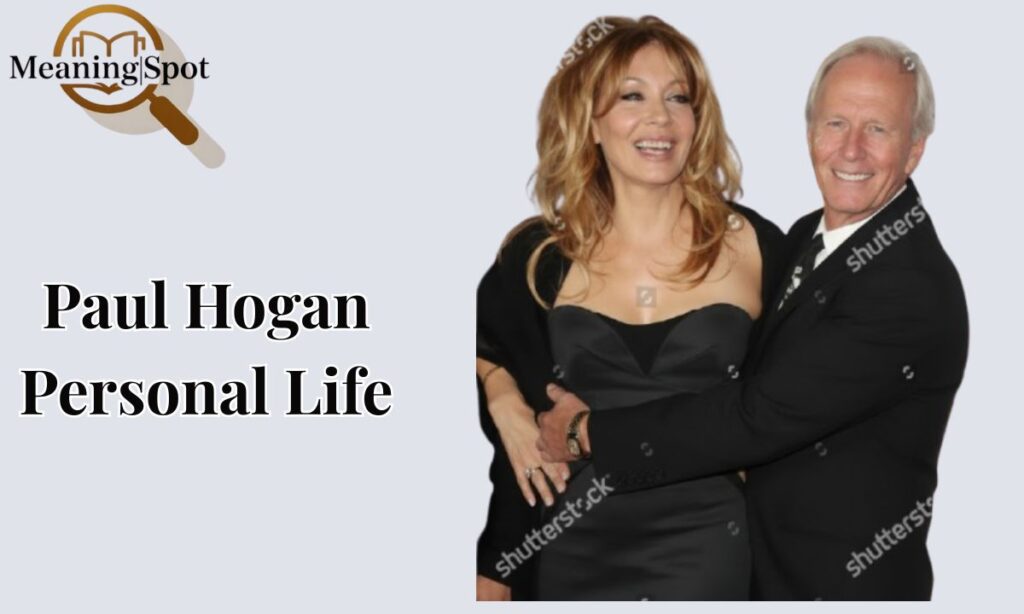
Hogan and his first wife, Noelene Edwards, were initially married from 1958 to 1981, a relationship that spanned more than two decades and included the early years of his career. They remarried within a year, then divorced again in 1986, suggesting a complicated relationship that couldn’t be permanently resolved. This second divorce was reportedly one of the most expensive and messiest in Australian history, attracting significant media attention and financial consequences. The settlement significantly impacted Paul Hogan net worth, though specific figures were never publicly disclosed.
Paul was married to his Crocodile Dundee co-star Linda Kozlowski from 1990 to 2014, a relationship that began on set and lasted for nearly a quarter century. The couple had one son together and appeared to have a strong partnership both personally and professionally. However, their divorce in 2014 was another financial blow to Hogan, further reducing his wealth during a period when he was already facing significant challenges. The end of this marriage marked a difficult personal chapter that coincided with his ongoing tax disputes.
Tax Fight
Hogan was involved in a bitter dispute with the Australian Taxation Office for more than a decade, a saga that dominated headlines and significantly impacted his reputation and finances. The tax office claimed that Paul used offshore tax shelters and California residency to hide millions of dollars worth of his “Crocodile Dundee” earnings over a period of 25 years. At one point, the tax office served Hogan with a $150 million bill that included significant fines and interest, a staggering sum that threatened to bankrupt him. In 2006, he won a $5 million judgment against the Australian Crime Commission after it was found to have illegally seized personal financial information, a rare victory in his ongoing battle.
In 2010, after Hogan traveled to Australia for his mother’s funeral, he was prevented from leaving the country until he paid off a $37.5 million tax bill, a traumatic experience that generated international headlines. In 2017, the Australian Commissioner of Taxation announced that the matter was settled after Hogan paid “tens of millions of dollars” in taxes and fines, though Paul denied those reports, maintaining his innocence throughout the ordeal.
Hogan also pursued a legal battle against his Swiss financial adviser, Philip Egglishaw, who allegedly misappropriated $34 million from his offshore accounts. Hogan successfully sued to recover the funds, which had been frozen amid the ATO investigation, though the process was lengthy and costly. The drawn-out dispute, part of Australia’s high-profile Operation Wickenby tax probe,
left Hogan deeply critical of the ATO, comparing them to the Taliban and branding officials as “a–holes” for damaging his reputation. By 2017, the matter was largely closed, but Hogan remained vocal about what he saw as unjust treatment, frequently insisting he had never engaged in tax evasion and had ultimately been vindicated. These legal battles significantly reduced Paul Hogan net worth from its peak of over $75 million.
Real Estate
One of his most famous properties was the Cedar Springs estate in Byron Bay’s hinterland, a 46-hectare private retreat he built with his then-wife, Linda Kozlowski, in the early 1990s. The estate, where the couple lived for over 15 years, was sold in 2006 for A$8.1 million, marking Hogan’s shift toward residing primarily in the U.S. This sale represented a departure from his Australian roots and reflected changing priorities during a tumultuous period in his life.
In 2009, he purchased a Malibu estate for $6.5 million, which he later sold to fellow Australian actor Chris Hemsworth in 2013 for $4.8 million, taking a significant loss on the property. This sale occurred during the height of his tax disputes and suggested financial pressure to liquidate assets. Hogan also owned a Santa Barbara home, which became his main residence during his tax dispute years, providing him a base in California away from the controversies in Australia.
In 2012, he attempted to sell either his Malibu or Santa Barbara home, ultimately choosing to keep Santa Barbara as his primary residence. While media speculated that his Malibu sale was tied to financial troubles, Hogan’s attorney denied any connection to his tax battle, though the timing suggested otherwise. These real estate transactions demonstrate how legal and financial pressures can impact even wealthy celebrities, forcing difficult decisions about valuable assets.
FAQ’s
What is Paul Hogan net worth in 2025?
Paul Hogan net worth currently stands at $20 million, significantly down from his peak of $75 million due to divorces and tax disputes.
How much did Paul Hogan earn from Crocodile Dundee?
Paul Hogan earned over $100 million from the Crocodile Dundee franchise by owning 60% of the first film’s profits.
Why did Paul Hogan’s net worth decline?
Paul Hogan net worth declined due to expensive divorces and a lengthy tax battle with the Australian Taxation Office that cost tens of millions.
Is Paul Hogan still married to Linda Kozlowski?
No, Paul Hogan and Linda Kozlowski divorced in 2014 after being married for 24 years.
Where does Paul Hogan live now?
Paul Hogan primarily resides in Santa Barbara, California, after selling his other properties during his financial difficulties.
Final Thoughts
Paul Hogan’s journey from Sydney Harbor Bridge rigger to international film star represents one of entertainment’s great success stories. His creation of the Crocodile Dundee character not only made him wealthy but also changed how the world viewed Australia, boosting tourism and putting Australian cinema on the global map. While Paul Hogan net worth has declined from its peak, his cultural legacy remains intact, and his contributions to entertainment continue to be celebrated worldwide.
Despite facing significant financial and personal challenges including costly divorces and a decade-long tax battle, Hogan has maintained his dignity and humor throughout. His story serves as both inspiration and cautionary tale about the complexities of wealth management and the importance of protecting one’s financial interests. Today, with Paul Hogan net worth at $20 million, he remains comfortable though far from his former financial heights, a reminder that even the most successful careers can face unexpected challenges.

Emma is an author at MeaningsSpot, where she crafts unique and inspiring names that spark creativity. With over 3 years of content writing experience, she specializes in making words meaningful and memorable.